
Edition 001 · 25 August 2026 · 2 min. read
When one per cent oxygen is too much: Colour in wet-aged beef
Brown or grey discoloration in vacuum-packed beef during the first weeks of wet ageing is not merely a cosmetic issue. Colour directly affects purchasing decisions, can lead to complaints and write-offs, and reflects chemical processes at the meat surface. A 2025 study by the University of Hohenheim and the German Institute of Food Technologies therefore examined how different oxygen concentrations affect colour stability.
One per cent oxygen drives an early rise in the brown oxidised form.
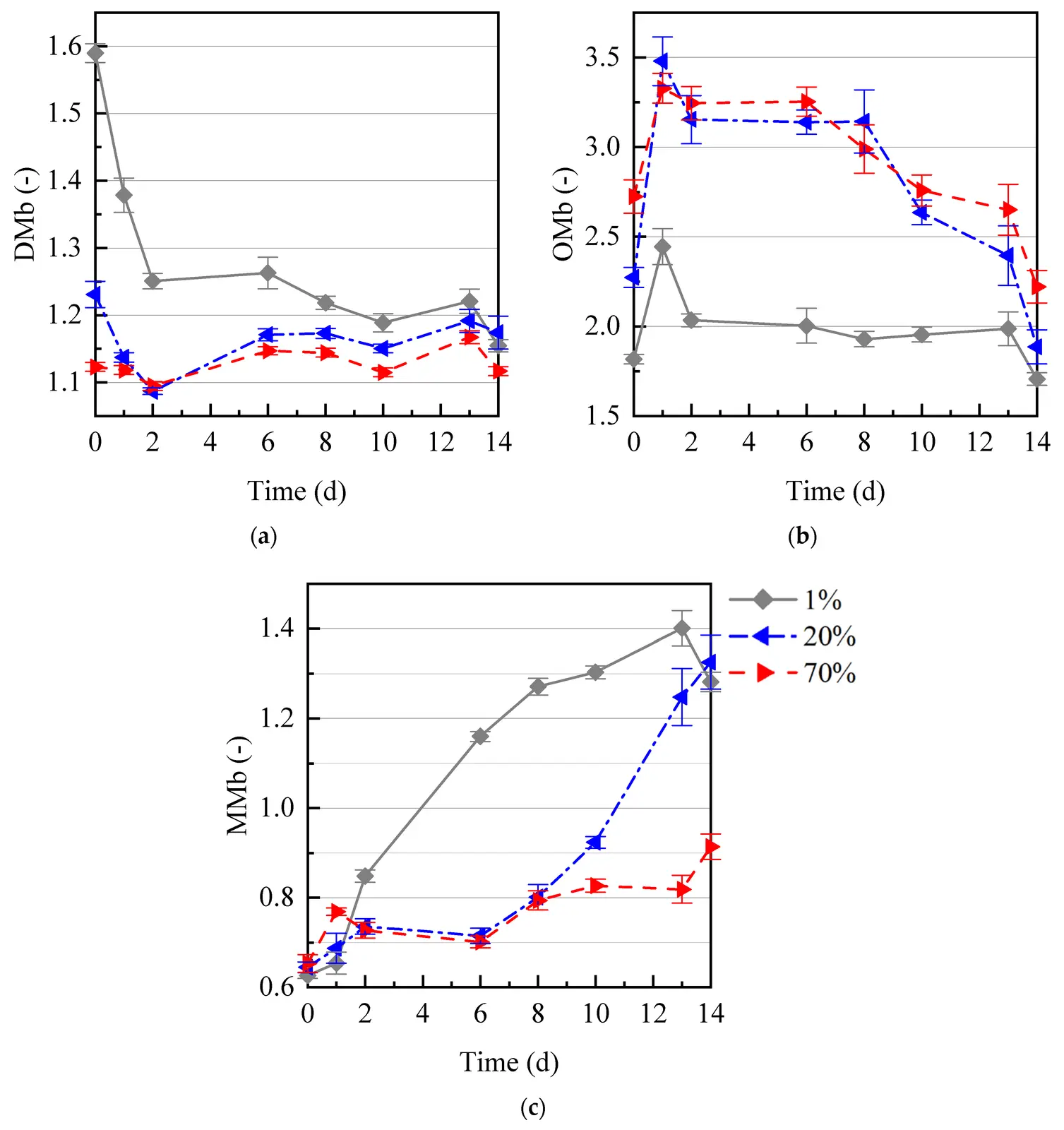
Relative levels of deoxy- (a), oxy- (b) and metmyoglobin (c) at 1, 20 and 70 per cent oxygen, stored for 14 days at 2 °C.
Slices of beef silverside were packed under atmospheres containing one, 20 and 70 per cent oxygen and stored for 14 days at two degrees Celsius. Colour and reflectance spectra were measured through the unopened pack. This made it possible to follow the visible changes and estimate the relative levels of deoxy-, oxy- and metmyoglobin. These three states of the muscle pigment explain why meat appears purple, bright cherry-red or increasingly brown.
The most critical finding concerns the apparently small residue. At one per cent oxygen, metmyoglobin formation had already increased markedly by day eight. Metmyoglobin is the brown oxidised form. In the 20 and 70 per cent groups, the increase was initially slower because more red oxymyoglobin formed. Higher oxygen did not prevent oxidation indefinitely; it delayed or partly masked it. By day 14, the 20 per cent group had also shifted strongly towards metmyoglobin, while 70 per cent maintained the red appearance for the longest period.
This is not an argument for oxygen-rich wet-ageing packs. The practical message is that oxygen must be excluded as completely as possible from a genuinely anaerobic vacuum pack. The range between “no oxygen” and a sufficiently high-oxygen atmosphere can be particularly unfavourable. Small leaks, inadequate vacuum performance, oxygen-permeable materials or residual gas can therefore promote early discoloration.
Colour nevertheless remains a signal rather than proof of spoilage on its own. Packaging integrity, temperature history, ageing time, aroma, surface condition and microbiological risk must be assessed together. The study provides an important piece of that assessment: a small oxygen input does not necessarily produce a small effect.